Single sitting RCT
PUBLISHED BY
Dr. Bharti Kaushik
Single-Sitting RCT: Complete Root Canal Treatment in One Visit
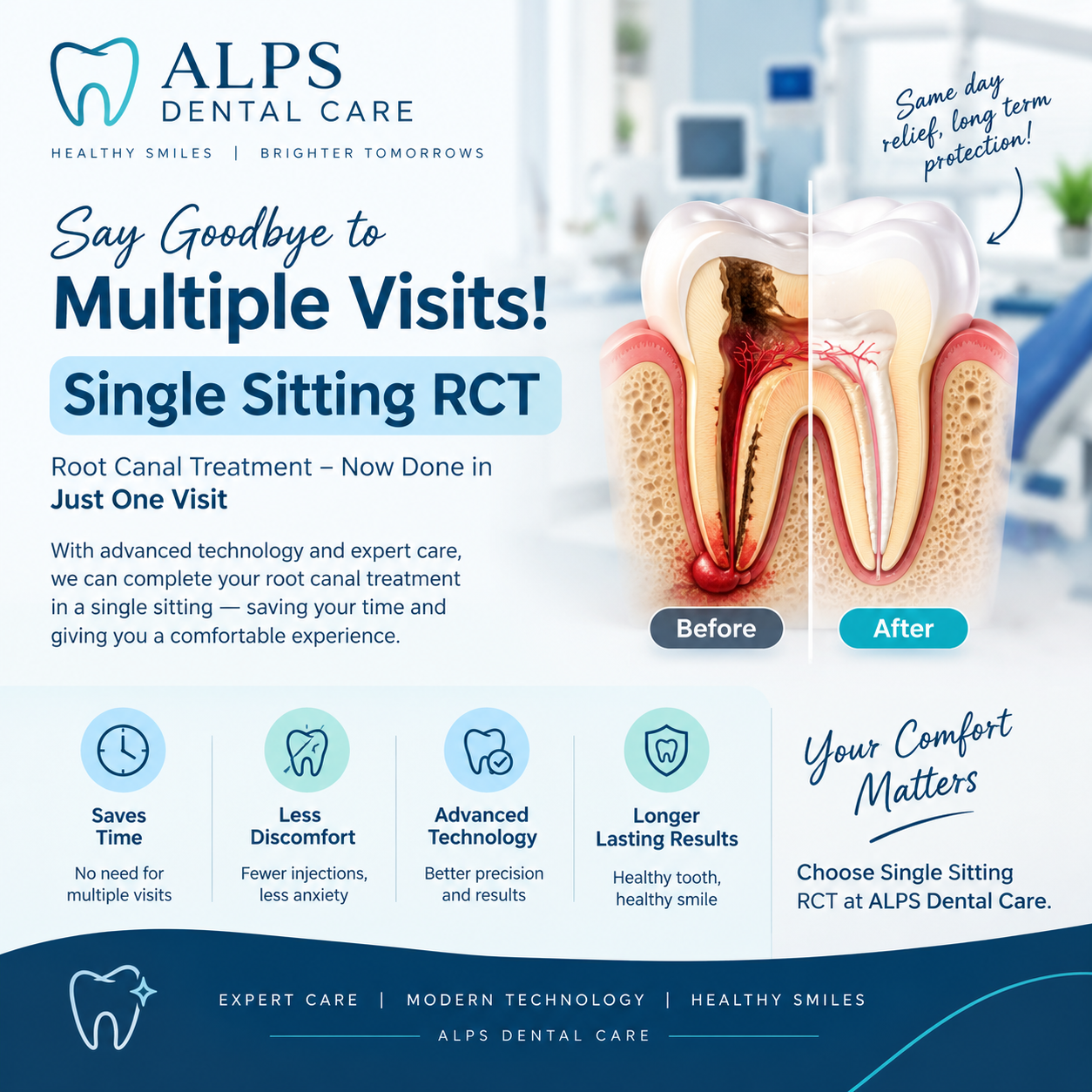
Single-sitting Root Canal Treatment (RCT) is an advanced approach that allows suitable root canal cases to be completed in a single appointment. For patients with busy schedules, it can reduce the number of dental visits while providing comprehensive treatment in one sitting.
At ALPS Dental Care, modern endodontic techniques and careful treatment planning are used to determine whether a tooth is suitable for single-visit RCT.
What Is Single-Sitting Root Canal Treatment?
Root Canal Treatment is performed when the pulp inside a tooth becomes inflamed or infected because of deep decay, trauma, cracks, or other dental problems.
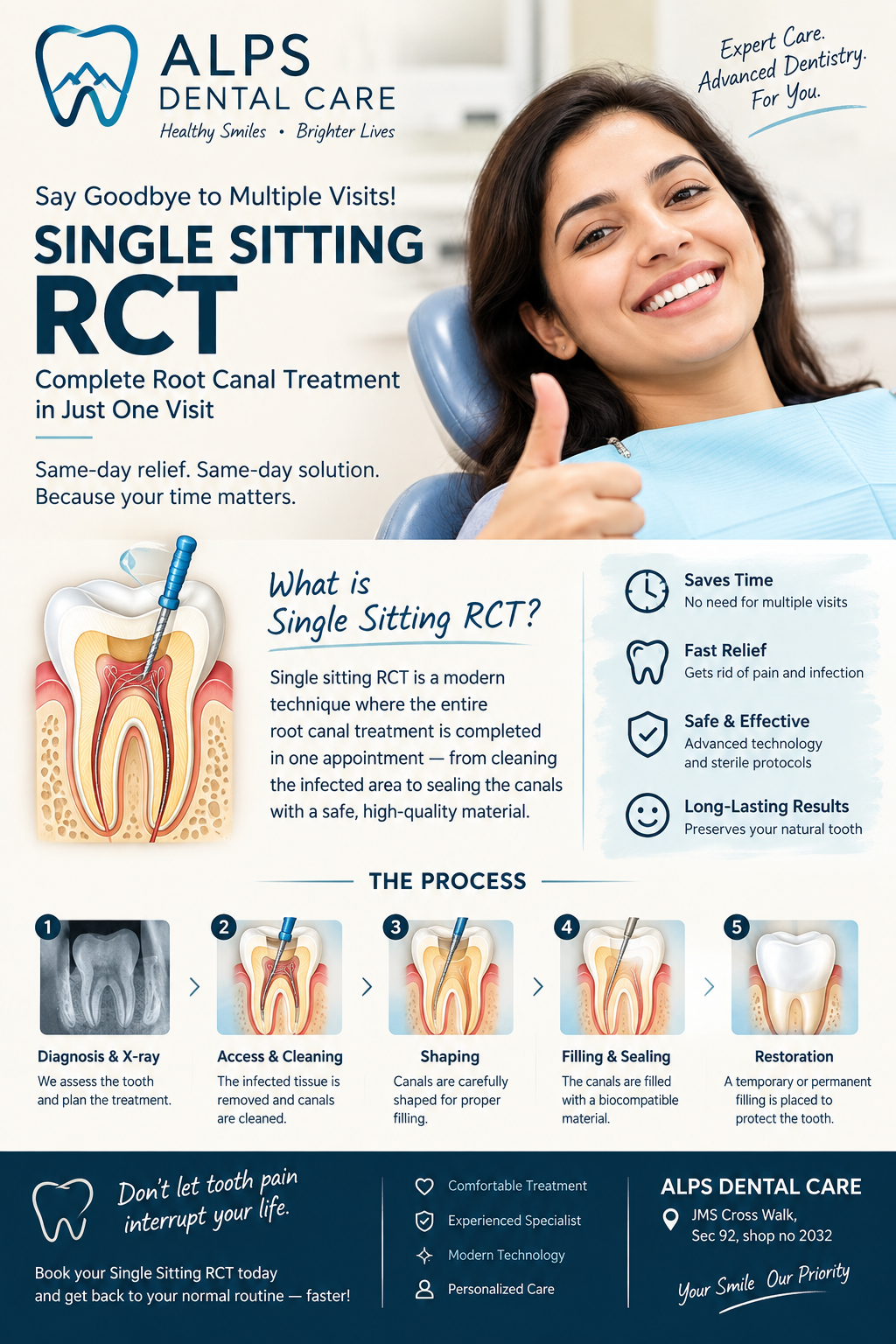
During RCT, the dentist:
Removes infected or inflamed pulp tissue
Cleans and shapes the root canals
Disinfects the canal system
Fills and seals the canals with an appropriate root-filling material
Restores the tooth to help protect it and restore function
Root canal treatment can often be completed in one or two appointments, depending on the individual tooth and clinical situation.
How Does Single-Sitting RCT Work?
A typical single-visit RCT may involve:
1. Diagnosis and Treatment Planning
The tooth is examined clinically and with appropriate dental imaging to determine the condition of the tooth, roots, and surrounding tissues.
2. Local Anaesthesia
The tooth and surrounding area are carefully numbed to make the procedure comfortable.
3. Isolation
A dental dam may be used to isolate the tooth and maintain a clean treatment field.
4. Cleaning and Shaping
The infected or inflamed pulp is removed, and the root canals are carefully cleaned and shaped.
5. Irrigation and Disinfection
Specialised irrigation protocols are used to help reduce microorganisms and debris within the root canal system.
6. Obturation
Once the canals are appropriately prepared and the clinical conditions are suitable, they are filled and sealed.
7. Final Restoration
After RCT, the tooth needs a suitable permanent restoration. Depending on the amount of tooth structure remaining and the location of the tooth, this may include a filling, onlay, or crown.
What Are the Benefits of Single-Sitting RCT?
For an appropriately selected case, completing RCT in one appointment may offer several practical benefits:
✔ Fewer dental appointments
Useful for patients with busy professional or personal schedules.
✔ Saves time
The endodontic treatment can be completed during one planned appointment.
✔ Earlier completion of treatment
The patient can proceed toward definitive restoration without waiting for another endodontic appointment.
✔ Convenient for patients travelling from another city
A single-visit approach may be particularly convenient when clinically appropriate.
✔ Modern endodontic techniques
Contemporary instruments, magnification, irrigation and imaging can assist the clinician in managing root canal treatment precisely.
Is Single-Sitting RCT Suitable for Everyone?
No. Single-sitting RCT is not automatically appropriate for every tooth.
The decision depends on factors such as:
The diagnosis
Pulpal and periapical condition
Presence and extent of infection
Root canal anatomy
Number and complexity of canals
Ability to adequately clean and disinfect the canal system
Patient symptoms and clinical findings
Remaining tooth structure
Whether the tooth can be predictably restored
The American Association of Endodontists notes that clinical circumstances and treatment complexity can influence the choice between single- and multiple-visit treatment.
Is Single-Sitting RCT as Effective as Multiple-Visit RCT?
Evidence does not show a clear difference in one-year radiographic outcomes between single-visit and multiple-visit root canal treatment in permanent teeth. However, the evidence also indicates that postoperative pain during the first week may be somewhat more common after single-visit treatment in some patients.
Therefore, the goal should not simply be to finish the treatment in one appointment. The priority is proper diagnosis, thorough cleaning and disinfection, effective sealing, and appropriate final restoration.
Does a Root Canal Treated Tooth Need a Crown?
In many cases, especially for posterior teeth, a strong definitive restoration is important after RCT to protect the remaining tooth structure.
The appropriate restoration depends on the tooth, the amount of remaining structure, its functional requirements, and other clinical factors. The AAE explains that a crown or another suitable restoration may be required to protect and restore the treated tooth.
Why Choose ALPS Dental Care for Single-Sitting RCT?
At ALPS Dental Care, every root canal case is evaluated individually. The treatment approach is selected according to the tooth's condition rather than simply following a fixed “one visit” protocol.
Our focus is on:
Accurate diagnosis
Modern endodontic techniques
Careful canal cleaning and shaping
Effective disinfection
Precise obturation
Comfortable patient care
Appropriate final restoration
Frequently Asked Questions
Is single-sitting RCT painful?
Modern local anaesthesia makes the procedure comfortable for most patients. Some tenderness or discomfort can occur after treatment.
How long does single-sitting RCT take?
Treatment time varies according to the tooth and canal complexity. A molar with multiple or complex canals may require considerably more time than a straightforward tooth.
Can an infected tooth be treated in one sitting?
Some infected teeth can be treated in one visit, but not every case is suitable. Your dentist should determine the appropriate treatment protocol after clinical and radiographic evaluation.
Is single-sitting RCT better than two-visit RCT?
There is no universal “better” option. The appropriate number of visits depends on the individual tooth and clinical circumstances.
What should I do after RCT?
Follow your dentist's instructions and arrange the definitive restoration promptly when advised. Avoid placing excessive force on a temporarily restored tooth.
Conclusion
Single-Sitting RCT can be a convenient and effective treatment option for carefully selected cases. However, successful root canal treatment depends on much more than completing the procedure in one appointment.
If you have severe tooth pain, sensitivity, swelling, deep decay, or a damaged tooth, a dental examination can help determine whether Root Canal Treatment is required and whether a single-visit approach is appropriate.
ALPS DENTAL CARE
Expert Care | Modern Technology | Healthy Smiles
Book a dental consultation to find out whether your tooth is suitable for Single-Sitting RCT.
"Clinical excellence is not just about state-of-the-art equipment—it's about the precision of care and the empathy of the provider."
Dr. Bharti Kaushik, Founder